What is CommissionOS?
CommissionOS (full name CommissionOS Launchpad) is a web-based tool for CPA affiliate marketers created by the WarriorPlus vendor DPAPA. You give it a CPA offer, and it generates traffic angles and audience ideas, builds a mobile-responsive prelander page, produces around 40 pieces of promotional content for different platforms, and lays out a 7-day action plan. It is software you log into, not a video course.
How much does CommissionOS cost?
The front end is $27 as a one-time payment. Behind it sit five optional upsells: an AI funnel builder at $67, a done-for-you campaign vault at $27, a paid traffic course at $47, a push-monetisation layer at $37, and an agency licence at $97. A VIP bundle containing everything is offered at $247. You only need the $27 front end for the core tool to work.
Is CommissionOS a scam?
No. The vendor has held a public WarriorPlus account since 2014, the product is sold through an established marketplace with a 30-day refund policy, and the software does what the sales page describes. The only expectation worth setting is that it builds the campaign rather than the audience — you still choose where your traffic comes from, and with that in place it delivers exactly what it promises.
Do I need to buy the upsells?
No. The $27 front end is a complete, working product on its own. The upsells add convenience, done-for-you assets and training rather than unlocking core functionality. If you are new, buy the front end, use it for a fortnight, and only then decide whether any upsell solves a problem you have actually hit.
What is CPA marketing?
CPA stands for cost per action. You are paid a fixed commission when someone you referred completes a specific action — submitting an email, installing an app, requesting a quote, signing up for a trial — rather than only when they buy something. Because the required action is smaller than a purchase, conversion rates are higher, which is why CPA is a common starting point for new affiliates.
Is CPA marketing the same as affiliate marketing?
CPA marketing is a subset of affiliate marketing. In classic affiliate marketing you usually earn a percentage of a sale. In CPA you earn a flat fee for a defined action that often is not a sale at all. Both are performance-based, and both are run through networks that track your referrals with a unique link.
Can beginners actually make money with CPA marketing?
Yes, and the beginners who do have three things in common: they get accepted into a decent network, they pick an offer that matches the traffic they can actually reach, and they run enough volume for the numbers to mean something. Good tooling removes the setup barrier so you reach that testing stage in days instead of weeks, which is where most of the drop-off used to happen.
Which CPA network should a beginner join first?
Start with one established network rather than five. MaxBounty, CPALead and CPAGrip all accept new affiliates, and incentive-friendly networks are usually the easiest approvals. Apply with a real website or a specific traffic plan, answer the phone or interview call if there is one, and be honest about being new — networks reject vagueness far more often than inexperience.
Does CommissionOS get me approved by CPA networks?
No, and no tool can. Network approval is a manual review of you and your traffic plan. What CommissionOS can do is give you a real prelander page and a written promotion plan to show an affiliate manager, which is more than most rejected applicants bring. The application itself is still yours to make.
Do I need paid traffic to run CPA offers?
Not necessarily, but you need traffic from somewhere. Free methods — short-form video, niche forums, targeted social content, SEO — are slower and demand consistency. Paid traffic buys speed and data at the cost of a testing budget you should expect to lose part of. Neither path is passive, and choosing one before you pick an offer is the wrong order.
What is a prelander and why does it matter?
A prelander (or bridge page) is the page a visitor sees between your traffic source and the offer page. It warms the visitor up, sets the context and filters out people who were never going to convert. Sending cold traffic straight to an offer page usually converts worse, and many traffic sources will not accept a raw affiliate link at all.
Does AI-generated promotional content actually convert?
Yes, and it converts best when you add your own angle on top. The 40-plus pieces CommissionOS produces solve the two hardest parts — the blank page and the volume that social platforms reward. Spend five minutes personalising each one and you have a week of posting ready before most people have written their first hook.
Does CommissionOS come with a refund guarantee?
Yes — a 30-day money-back guarantee, processed through WarriorPlus. Keep your purchase receipt and request refunds through the marketplace rather than by email alone, since WarriorPlus is the payment processor and holds the record of the transaction.
Who gets the most out of CommissionOS?
Anyone who already has somewhere to send traffic — a social account they post on daily, a small ad budget, an email list, a niche community. For them the tool removes the entire setup barrier and campaigns go live the same day. If you have not chosen a traffic source yet, start there, then come back and the tool will slot straight in.
Have you actually run CommissionOS?
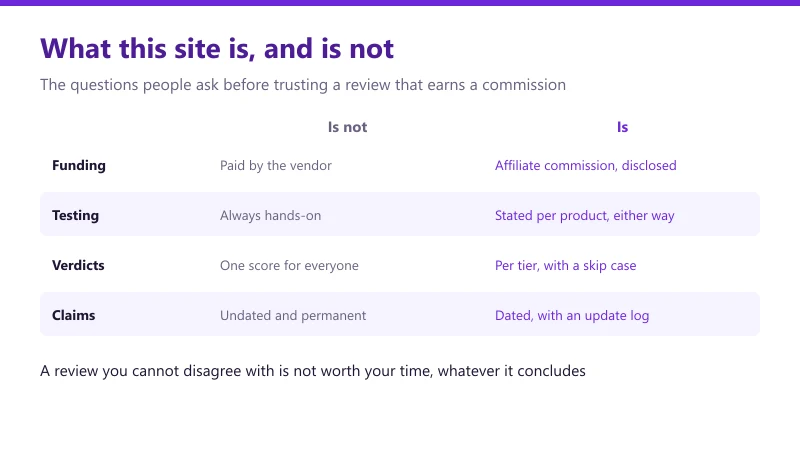
No, and we say so on the page rather than leaving it to be assumed. Everything above describes the documented workflow and the decision around it — not performance we could vouch for. Most reviews of a product this new quietly skip that distinction, and screenshots lifted from a sales page read exactly like screenshots from use. If we run it later, the review gets an update log entry with the date, not a silent rewrite.
Is $27 cheap or is that the point?
It is deliberately low, and that is a legitimate pricing strategy rather than a red flag by itself. A $27 front end exists to get you into a funnel where the upsells carry the margin — which is why the funnel section above lists every tier with a separate verdict instead of reviewing the front end alone. The question worth asking is not whether $27 is cheap but whether the $27 product is usable without the upsells. If it is not, the real price is the bundle price.
Will this tool find me a winning offer?
No, and no tool will. Offers rise and die on advertiser budgets, traffic quality and network caps — all of which change weekly and none of which any software can see from the outside. What a tool can do is shorten the work of testing an offer you already have access to. Anyone promising offer selection is selling the one thing that cannot be automated.
I have no network approval yet. Should I buy it first?
No. Every job this tool does begins with an offer you can promote, so without approval you would own a workflow with nothing to put through it. Fix approval first — our guide on getting approved by CPA networks covers what applications actually get rejected for, and it is free. Buying tooling before access is the most common way beginners spend money without moving.
What should I do in the first week if I buy it?
Run one offer through every step on day one rather than sampling features, because a tool like this is a sequence and testing it in pieces tells you nothing. On day two, write one angle and one piece of copy yourself and compare them with the generated equivalents — that twenty-minute test answers your real question. Publish by day five, decide on the refund by day six with the deadline already in your calendar, and on day seven write down whatever actually stopped you. That last sentence is usually worth more than the purchase.
How do I judge any CPA tool review, including this one?
Four checks. Does it say whether the writer ran the product? Does it name anyone the product is wrong for — a review with no disqualifying case is a sales page with a score attached. Does it compare against doing nothing, not just against competitors? And does it date its claims, so you can tell a current fact from a snapshot that quietly rotted? We carry affiliate links and say so; what should earn your trust is whether we gave you enough to disagree with us.
Can I get a refund, and how should I think about the window?
Refund terms are set by the vendor and the marketplace it sells through, not by us, so check them on the checkout page before you pay rather than after — and screenshot what they say. The practical advice is simpler than the policy: put the deadline in your calendar on the day you buy, and run the one-offer test in the first six days. A tool that has not produced one usable asset in six days is unlikely to in the seventh, and using a refund window is not a failure — it is what the window is for.
Do I need the upsells for the front-end product to be usable?
That is the question that decides whether the real price is 7 or the bundle price, and it is the first thing to establish on the checkout page: read what the front end includes on its own, with the upsell pages closed. A low front end exists to open a funnel, which is a normal strategy and not a red flag by itself — but it becomes one if the entry product is a demo rather than a product. Our funnel section gives a separate verdict per tier for exactly this reason.